Tuesday, January 31, 2012

More Vintage Hoop Shots!


These were too good not to share --- part of a little something I'm working on today, here are some University of Alabama basketball action shots and players from the 1940s-60s! Roll Tide!

Vintage Kicks, Vintage Hardwood


This cool and mysterious photograph is of the feet of the 1964 University of Alabama basketball team, part of the University of Alabama photographs collections. The vintage hardwood is Foster Auditorium, where Men's basketball played before the days of Coleman Coliseum. The sneakers and the venue have changed, but it always is an exciting couple of hours, cheering on the Crimson Tide basketball team! And if you can't make it to see them live, there's always ESPN! Roll Tide!

Tuesday, January 17, 2012

Summersell Center Fellowships Call for Applications!


Summersell Center Announces 2012 Short-Term Fellowship Program

To support the study of southern history and promote the use of the collections housed at the University of Alabama, the Frances S. Summersell Center for the Study of the South will offer four fellowships in the amount of $500 each for researchers whose projects entail work to be conducted in southern history or southern studies at the W.S. Hoole Special Collections Library (http://www.lib.ua.edu/libraries/hoole/), the A.S. Williams III Americana Collection (http://www.lib.ua.edu/williamscollection), or in other University of Alabama collections.

Applicants should send two copies of

  • A current CV
  • One letter of recommendation (which may be sent under separate cover)
  • A description of the research project, no longer than two double-spaced pages, which includes a description of the particular resources to be used during the term of the fellowship

The deadline for applications to be received by the Summersell Center is March 16, 2012. Decisions regarding awards will be made by May 1, 2012, and research may be conducted anytime between June 1, 2012 and May 31, 2013. Both academic and non-academic researchers at any stage of their careers are encouraged to apply. Because fellowships are designed primarily to help defray travel and lodging expenses, however, eligibility is restricted to researchers living outside the Tuscaloosa area.

Send all application materials to:
Frances S. Summersell Center for the Study of the South
Department of History
University of Alabama
Box 870212, 202 ten Hoor Hall
Tuscaloosa, AL 35487

Any questions about the fellowships may be directed to Joshua Rothman, Director of the Summersell Center, at jrothman@bama.ua.edu or 205.348.3818.

Thursday, December 15, 2011

Remembering the Queen of the Blues


Nearly 50 years ago this week, Dinah Washington passed away at the young age of 39. Dinah Washington was born Ruth Lee Jones in 1924 in Tuscaloosa, Alabama. Moving with her family at a young age to Chicago, she went on to become one of the most distinctive singers of her time. Her biggest triumph came with the 1959 Grammy-winning “What a Diff'rence a Day Makes" and she topped the charts again with “Baby, You’ve Got What it takes” a sizzling duet with Brook Benton. A gospel star at age fifteen, she was discovered by the legendary musician and fellow Alabamian Lionel Hampton at eighteen. She spent most of the rest of her short life in clubs and theaters and in the studio --- making music.

Dinah's distinctive and heartfelt voice quickly became her trademark -- she was a song stylist, crossing over from the "race music" category to the pop and jazz charts. Known in her day as the Queen of the Blues and queen of the Juke Boxes, Dinah was regarded as a rare "first take" artist, her studio recordings reflecting the same passion that she brought o every one of her live performances. She was known to make every single song she sang her own, having once said, George Gershwin wouldn't know his own song when I'm through with it. I can't stay hidebound to any melody."


Please enjoy Dinah's remarkable live performance of All of Me from 1958, complete with a very participatory audience. She was loved, and continues to be loved for her remarkable singing voice, an unmistakable sound that can never be matched. And she lived a fascinating, sad, and far too short of a life. To read more about Dinah, read Nadine Cohodas's book, Queen: The Life and Music of Dinah Washington ( Pantheon, 2004). Much of the research on Dinah's earliest years was done at the Hoole Library! She spoke to a rapt audience at UA in 2005 about her book -- we even had a little Dinah-esque performance with blues singer, Elnora Spencer.


Not to be outdone, Nadine's latest book,
Princess Noire: The Tumultuous Reign of Nina Simone (Pantheon, 2010) is a look at the fascinating life of this incredible singer and activist. Mark your calendars -- Nadine may be joining us again in spring 2012 to talk about her work!


Monday, December 12, 2011

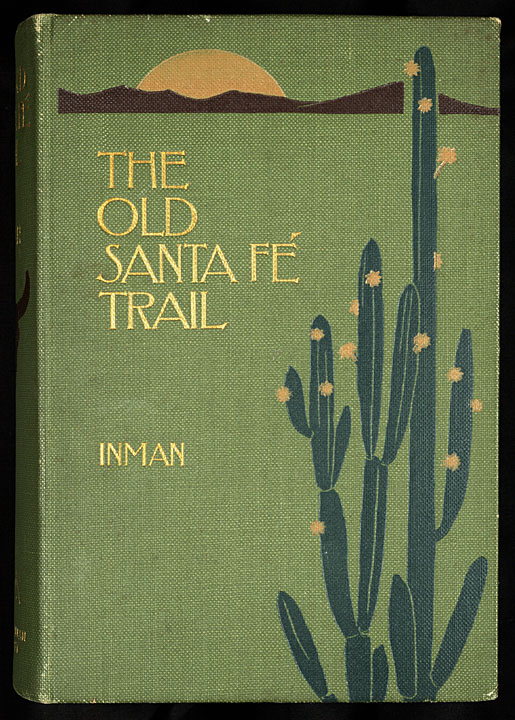
Two Kinds of Santas!


Both on publishers' bindings, and both in glorious green cloth.
The Old Santa Fe Trail (Macmillan Co., 1898, from the Hoole Richard Minsky Collection) and A Captured Santa Claus (Charles Scribner's Sons, 1905, from the Wade Hall Collection of Southern History and Culture) Both of these books are included in the award-winning digital project, Publishers' Bindings Online, 1815-1930: The Art of Books.

Thursday, December 8, 2011

The Bad Seed is the Big Shocker!

Al Hirshfeld's drawing of the cast of the play, The Bad Seed, published in the New York Times, December 5, 1954.
Can you find the "Ninas"?


Fifty-seven years ago today, on December 8, 1954, the Sherwood Anderson theatrical adaptation of William March's novel, The Bad Seed opened on Broadway. March, born William Campbell, was a native of Alabama and a former student of The University of Alabama.

If you haven't read the novel, you should. And though we can't travel back in time to see the play as it first appeared, most of the actors moved from stage to screen for the 1956 film adaptation.


March's papers are held in the Hoole Library, and there is a larger-than-life bust of him in our reading room too. A fascinating man of many talents, look for more on March in the months to come! In the meantime, make some popcorn, get under a blanket, and watch one of the creepiest children of American cinema do her stuff.


Notice from the Tuscaloosa News, 1956 on the film, The Bad Seed


Friday, November 18, 2011

Great Literature in Different Packages: Moby-Dick


Moby Dick by Herman Melville. Armed Services Edition
New York : Council on Books in Wartime, 1944

AC 1 .A7 G-209


Moby Dick Comic. Authorized Edition
New York : Dell Pub. Co., 1956.
Hoole Library Harold E. Selesky Comic Collection


On November 14, 1851, one hundred and sixty years ago this week, the great American novel Moby-Dick was first published in a single volume in the United States by Harper and Brothers.

Though the novel had very limited success during Melville's lifetime and beyond (he died in 1891), it stands today as part of the Western canon, and one of the most important American novels.

The "Melville Revival" began around the time of World War I, when the novel found new relevance in the wake of the Modernist movement. The book continues to speak to readers, with complex metaphors representing good and evil, power, and class. Literary critic Nick Selby said, "Moby-Dick was now read as a text that reflected the power struggles of a world concerned to uphold democracy, and of a country seeking an identity for itself within that world."

These two examples of Moby-Dick shown here represent interesting examples of the rethinking and repackaging of great American literature. The first, an example of an Armed Services Edition, offers a compact version of the novel to American servicemen. These small paperbacks were distributed widely during World War II and exposed soldiers to a variety of great works of both the 19th and 20th centuries, along with a variety of other materials. The Hoole Library holds nearly a complete collection of Armed Services editions, one of the most complete collections held in libraries.

The second image is the cover of the 1956 Dell comic edition of Moby-Dick, based on the 1956 film starring Gregory Peck (best known by fans great Alabama literature as the beloved Atticus Finch in the film version of Harper Lee's To Kill a Mockingbird) as the tyrannical Captain Ahab. Though this is a far cry from Melville's dense prose, it is a welcome introduction to the great American authors, perhaps inspiring children to take the leap from comics to great American Literature! But there is room for every form and interpretation of this epic tale.